
The Life of İsmet İnönü
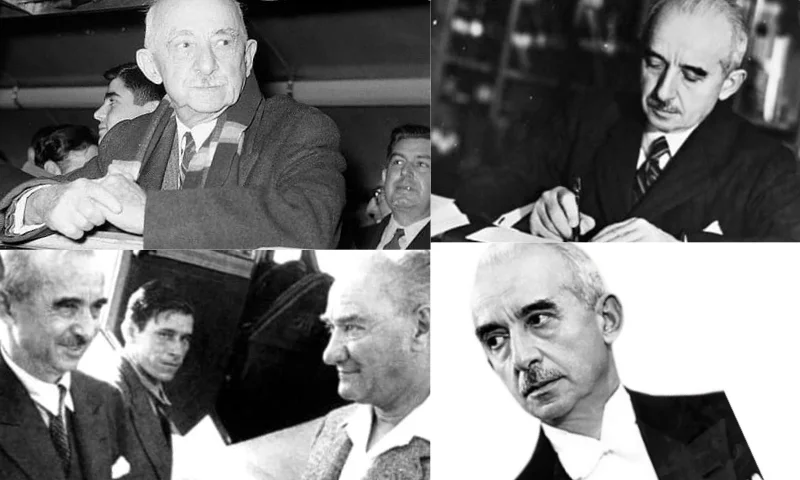
Mustafa İsmet İnönü was born on September 24, 1884, in İzmir. İsmet İnönü was the second son of the family. His father was Reşit Efendi, and his mother was Cevriye Temelli Hanım. İsmet İnönü completed his primary and secondary education in Sivas. In 1895, he enrolled in the Sivas Military Rüştiye (middle school). He graduated from this school in 1896. In 1897, he attended the Mühendishane İdadisi (military high school) in Istanbul. In 1901, he entered the artillery school and graduated as an artillery second lieutenant in 1903. On September 26, 1906, he graduated first from the Staff College. He was then appointed as a battalion commander in Edirne with the rank of Staff Captain. In 1908, İsmet İnönü, who was the staff of the 2nd Cavalry Squadron, later took part in the March 31st Incident. Serving as a commander in Yemen in 1911, İsmet İnönü became a Binbaşı (Major) in 1912. Known to have served in the Second Balkan War between 1912 and 1913, İsmet İnönü later sat at the negotiation table with the Bulgarians as a military advisor. He is also known to have participated in efforts to modernize the army. To get information on this subject and to ask questions you are curious about, you can look at the relevant online firms on internet pages and examine them in detail from here.
Ismet İnönü's Military and Political Life
Becoming a Yarbay (Lieutenant Colonel) in 1914 and a Colonel in 1915, İsmet İnönü first gained recognition in World War I. During the war, he was appointed Commander of the 4th Corps by Mustafa Kemal. İsmet İnönü also served in Aleppo and Palestine during World War I. During these times, he established close relations with Mustafa Kemal. When he was wounded at the front, he went to Istanbul for a while. İsmet İnönü was promoted to Undersecretary and then to Military Undersecretary shortly before the War of Independence. On April 9, 1920, at Mustafa Kemal's recommendation, he severed all ties with Istanbul. Two weeks later, he joined the Grand National Assembly as a Member of Parliament for Edirne. On June 6, 1920, the Court of Cassation issued a death sentence against him. On May 3, he was elected Chief of the General Staff. During the War of Independence, he served in the 1st İnönü Battle, the 2nd İnönü Battle, the Sakarya Field Battle, and the Great Offensive. After the war, he was sent to Lausanne to reach an agreement with the Allied Powers. After his success in the Treaty of Lausanne, he began serving as Prime Minister in the newly established Republican Government. In the early years of his premiership, he played a significant role in the closure of the Progressive Republican Party, which held views partially opposed to Mustafa Kemal's.
Ismet İnönü's Ideological Approaches
During his premiership, he pursued a neutral policy, doing everything possible to avoid entering any war. He played a significant role in the Menemen Incident, the Sheikh Said Rebellion, and the Dersim events. He is the person who made the law for the call to prayer to be recited in Turkish. Together with Mustafa Kemal, they implemented many innovations such as the inclusion of secularism in the Constitution, the Alphabet Revolution, the Hat Revolution, and the Calendar Revolution. He had an important role in the Tehran Pact and the Balkan Entente signed during his premiership. After Mustafa Kemal's death, he was elected President in an extraordinary meeting. During his presidency, he gave himself the title of National Chief. During his presidency, he did everything he could to prevent Turkey from entering World War II. He managed to stay away from the war by pursuing a neutral policy. However, this policy prevented Turkey from acquiring Libya as a province. Later, this situation also caused some harm to the country in terms of science. While İsmet İnönü was serving as President, four names in his party broke away from the CHP, declared the "Four-Man Tally," and founded a new party against him. The two most important figures of the newly founded Democratic Party were Celal Bayar and Adnan Menderes. İsmet İnönü managed to stay in power a while longer in the first elections thanks to the open voting, secret counting method. However, in the impartial elections held in 1950, he lost power to the DP. After serving as the leader of the Opposition Party for a while, İsmet İnönü served as Prime Minister again after the 1960 coup. İnönü, whose premiership ended in 1965, resigned from the CHP in 1972. He passed away in Ankara on December 25, 1973, at the age of 89.